

When a gear pump or screw pump is used in an oil, gas or petrochemical process, API 676 often appears in the equipment specification, datasheet or vendor quotation. Buyers sometimes read this as a simple certification requirement: if the pump carries the API 676 label, it must be the right pump.
That is not quite how the standard works.
API 676 is a procurement and design standard for rotary positive displacement process pumps and pump units used in petroleum, petrochemical and gas-industry services. The current edition is the fourth edition, published in February 2022. It establishes minimum requirements and also assigns important decisions to the purchaser, such as the service conditions, materials, testing, documentation and special features required for a particular project. 1
This is why API 676 keeps coming up. It gives the buyer and the manufacturer a common technical language for equipment that may be handling hot oil, high-viscosity hydrocarbons, chemicals, fuel, corrosive liquids or other fluids where a pump failure can stop production or create a safety problem.
It does not mean that every gear pump or screw pump in every industry must be designed to API 676. Nor does the phrase “API 676 pump” replace a review of the actual process duty.
What API 676 actually covers
API 676 covers rotary positive displacement process pumps and pump units for petroleum, petrochemical and gas-industry services. Rotary positive displacement pumps move fluid by trapping a volume and carrying it from the suction side to the discharge side as the rotor turns.
Depending on the pump design, the rotating elements may be gears, screws, lobes, vanes or another rotary displacement mechanism. Gear pumps and screw pumps are therefore within the type of equipment commonly associated with API 676. Progressive-cavity pumps may also be specified to API 676 when the project and manufacturer apply the standard to that pump design, but the exact scope and deviations should be confirmed in the inquiry documents.
The standard is not the same as a general industrial pump catalogue specification. It addresses the pump and, where applicable, the complete pump unit. That can include the driver, baseplate, coupling, auxiliaries, instrumentation, piping interfaces, inspection, testing and documentation.
API 676 also identifies equipment that is outside its scope. Controlled-volume pumps, hydraulically driven pumps and reciprocating positive displacement pumps are not covered by API 676. API 674 is associated with reciprocating positive displacement pumps, while API 675 covers controlled-volume pumps. For general auxiliary services such as some lube-oil systems, the standard indicates that a manufacturer’s standard design with demonstrated experience may be acceptable. 1
That distinction matters during procurement. A purchaser should not write “API 676 required” without first confirming the pump type, service category and project specification.
Why buyers use API 676
It turns a short equipment description into a real purchase specification
A request such as “supply a 30 m³/h gear pump at 8 bar” is not enough for a critical process service. It does not say how the pump will behave at start-up, what the liquid viscosity will be, how much vapour may be present, what materials are required, how the shaft will be sealed or what documents the supplier must submit.
API 676 provides a structured basis for filling in those gaps. Its purchaser datasheets and enquiry requirements prompt the user to define the service rather than leaving every decision to the supplier. The standard itself states that the purchaser must specify certain details and features. 1
This is one of its most useful functions. It makes the buyer describe the equipment that is actually needed instead of buying a nominal pump size.
It sets a common minimum for design and manufacturing
An API standard does not guarantee that a pump will last forever. It does, however, establish a common minimum level for design, construction, inspection and testing when the standard is correctly applied.
For the purchaser, that usually means a more disciplined review of pressure-containing parts, rotor and shaft design, bearings, lubrication, materials, welding, examination, mounting, coupling and performance. For the manufacturer, it means that important design choices cannot be treated as informal catalogue details.
Viking Pump, for example, describes API 676 as applying to rotary positive displacement pumps such as its internal gear pumps and highlights requirements involving pressure-containing parts, bearing life, nondestructive examination and mounting-foot flatness. 2 Those examples illustrate why API 676 specifications tend to be more detailed than a standard commercial pump quotation.
It makes vendor comparison more meaningful
Two suppliers may offer pumps with the same nominal capacity and pressure rating but with very different assumptions about viscosity, speed, clearances, seal arrangement, bearing life, relief protection and test scope.
A properly written API 676 inquiry makes those assumptions visible. The purchaser can then compare the offers on more than price and catalogue capacity.
This is particularly important for rotary positive displacement pumps because the actual flow is affected by internal slip. Internal slip changes with differential pressure, viscosity, speed, temperature and running clearances. A pump that meets its theoretical displacement may not deliver the same flow at the actual operating point.
For screw pumps, the relationship between clearance, pressure, viscosity and efficiency is especially important. Leistritz’s technical material describes API 676 screw-pump applications in heavy-oil pipelines and shows why flow, torque, viscosity, differential pressure, start-up conditions and total operating cost must be considered together. 3
Why gear pumps and screw pumps often need different API 676 discussions
API 676 provides a common framework, but it does not make different pump technologies behave in the same way.
Gear pumps
External and internal gear pumps are often selected for clean or moderately contaminated liquids, oils, fuels, polymers, asphalt and other fluids where a compact rotary displacement pump is appropriate. The main selection issues may include viscosity, lubrication, differential pressure, tooth loading, bearing loads, internal clearances, solids tolerance and relief-valve protection.
A gear pump can continue to build pressure if the discharge line is blocked. The pump package therefore needs a properly considered relief or pressure-limiting arrangement. The relief valve protects the pump and system; it does not make an unsuitable pump suitable for a blocked or closed discharge.
The buyer should also clarify whether the gears are supported by internal bearings or external bearings, whether the pumped liquid lubricates the bearings, and how the pump will behave during cold start-up. A heavy liquid that is acceptable at operating temperature may impose very high starting torque when cold.
Screw pumps
Screw pumps are commonly used for oils, viscous hydrocarbons, lubricating liquids and some multiphase or gas-entrained services. Their performance depends on the number and arrangement of screws, whether the rotors are timed or untimed, the internal clearances, the liquid viscosity and the pressure difference.
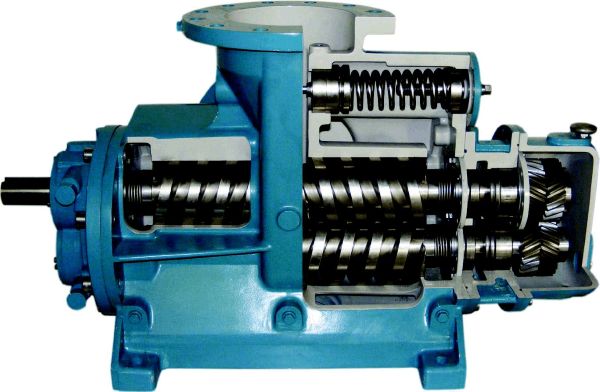
Untimed screw pumps rely on the pumped fluid and the pump geometry to maintain the required relationship between the rotating elements. Timed screw pumps use timing gears to maintain rotor phase and can provide a different approach to solids handling and internal clearances. These are not interchangeable features; they need to be selected for the actual process.
Screw pumps are often considered for heavy-oil pipeline service because their performance can be less sensitive to viscosity changes than that of a centrifugal pump, especially during cold start-up. That does not make them automatically more efficient in every service. The buyer should compare the complete duty cycle, including start-up, normal operation, minimum flow, maximum pressure, driver power and maintenance.
What API 676 changes in the buying process
The most important practical change is that the purchase becomes a documented engineering process rather than a simple product selection.
The datasheet becomes part of the technical contract
The purchaser should provide the supplier with a completed or substantially completed datasheet. It should include the fluid name and composition, flow range, suction pressure, discharge pressure, differential pressure, temperature range, viscosity range, density, vapour pressure, solids, gas content, hazardous-area requirements and operating pattern.
For a difficult liquid, “oil” or “chemical liquid” is not sufficient. The supplier needs the properties at the conditions that matter. Viscosity at start-up may be more important than viscosity at normal operation. Vapour pressure and suction pressure may be more important than the nominal flow rate. Water, gas, sand, wax and corrosive components may determine the materials and seal design.
API 676 includes purchaser datasheet guidance and gives the purchaser a clear role in specifying details. 1 If the datasheet is incomplete, the vendor will fill the gaps with assumptions. Those assumptions should be listed and accepted explicitly rather than discovered after the pump is delivered.
Deviations must be visible
A pump can be described as “API 676 compliant” while still containing purchaser-approved deviations, project additions or vendor interpretations. The important question is not whether the words appear on the quotation. The important question is which edition applies, which clauses are included, which clauses are excluded and who accepted each deviation.
Ask the vendor to provide a clause-by-clause compliance statement or an exception list. The list should identify:
- the edition of API 676 used;
- all proposed deviations;
- any alternative materials or components;
- the applicable testing and inspection scope;
- seal and auxiliary-system standards invoked by the project;
- driver, coupling and baseplate requirements; and
- items supplied by others.
“Designed in accordance with API 676” is not the same as “fully compliant with API 676.” “API 676 equivalent” is even less precise. The purchaser should require the supplier to define the statement in writing.
Testing and inspection become planned activities
For a non-critical commercial pump, the buyer may accept a manufacturer’s routine test. For an API 676 process pump, the purchase order may require additional inspection, material certification, nondestructive examination, dimensional checks, hydrostatic testing, mechanical running testing, performance testing or witness and hold points.
The exact requirements depend on the project specification and the purchaser’s selection in the datasheet. API 676 provides a framework; it does not mean that every pump automatically receives every possible test.
The inspection and test plan should be agreed before manufacturing starts. It should identify the test standard, acceptance criteria, test medium, test speed, test pressure, instrumentation, calibration requirements, purchaser notification time and treatment of failed or repeated tests.
A certificate saying “tested to API 676” is not a substitute for the actual test record. The purchaser should receive the documents needed to understand what was tested and under what conditions.
The equipment details that deserve the most attention
Pressure and temperature limits
The maximum allowable working pressure of the casing is not necessarily the same as the normal discharge pressure. The buyer should review casing design pressure, design temperature, pressure at shutoff or blocked discharge, relief-valve setting, hydrostatic test pressure and the pressure rating of connected components.
For hot oils, asphalt, polymer and other temperature-sensitive fluids, thermal expansion and cold-start conditions can be equally important. The pump may need a jacket, tracing, a heating procedure or a defined warm-up time.
Shaft sealing
The seal arrangement should be selected from the process conditions, not copied from a previous pump. Consider fluid toxicity, flammability, vapour pressure, temperature, solids, pressure direction, emissions limits and the availability of seal-support utilities.
API 676 may be used together with other project standards for mechanical seals and seal-support systems. The purchase documents should state exactly which seal standard and arrangement apply. The vendor should show the seal chamber, faces, elastomers, flush or barrier system, pressure limits and instrumentation.
Bearings, lubrication and shaft loading
Rotary positive displacement pumps can impose substantial radial and axial loads, particularly at high differential pressure and high viscosity. The buyer should review bearing type, bearing life calculation, lubrication method, oil or grease requirements, cooling, shaft deflection and the effect of driver or coupling loads.
For a gear pump, the gear reaction and pressure loading are important. For a screw pump, rotor loads, clearances, timing gears, balance arrangements and thermal growth may control the design.
The manufacturer should state whether the pumped fluid lubricates any internal bearing or bushing. A fluid that contains water, solids or corrosive components may not provide reliable lubrication even if its viscosity appears suitable.
Relief protection
A positive displacement pump must have a safe response to a restricted discharge. The pump’s internal relief valve, an external relief valve or another approved pressure-protection arrangement may be used, depending on the project design.
The purchase specification should make clear who supplies the device, where it is installed, how it is set, where the relieved fluid goes and how the system behaves during a blocked discharge. Do not assume that a relief valve mounted on the pump automatically protects every part of the downstream system.
Baseplate, piping and nozzle loads
The pump is part of a connected system. Excessive pipe strain can distort the casing, change clearances and increase vibration. The purchaser should define the allowable nozzle loads, piping arrangement, support conditions, baseplate requirements, grout or mounting method and alignment procedure.
A pump that passes a shop test can still suffer field problems if the suction line is undersized, the pipe is poorly supported or the pump is misaligned after installation.
Driver and hazardous-area requirements
The selected motor, gearbox, turbine or other driver must cover the maximum required torque, including start-up and upset conditions. A motor sized only for normal running power may trip when a viscous product is cold.
The equipment specification should also identify the area classification, electrical requirements, ambient conditions, noise limits, coupling guard, rotation direction and required driver testing. These details may come from other API standards or site standards, but they still need to be coordinated with the API 676 pump package.
What API 676 does not decide for you
API 676 is not a pump-sizing program. It does not know the viscosity curve of your product, the pressure drop in your pipeline, the sand concentration in your well fluid or the consequences of a shutdown at your site.
It also does not select the best pump technology. A gear pump, twin-screw pump, three-screw pump or progressive-cavity pump may each be suitable for different duties. The standard creates a framework for the selected pump; it does not remove the need for process engineering.
It does not replace:
- hydraulic and process calculations;
- suction-condition review;
- materials and corrosion engineering;
- hazardous-area classification;
- relief-system design;
- seal-support design;
- electrical and control-system design;
- installation alignment and piping review; or
- a maintenance and spare-parts strategy.
It is also important to remember that API standards are used voluntarily unless a contract, regulation, authority or project specification makes them applicable. The API 676 preview states that the standard is intended to support procurement and manufacture and that sound engineering judgment remains necessary. 1
How to compare two API 676 pump quotations
Start by checking whether both vendors are quoting the same service. Compare the fluid properties, design point, minimum and maximum flow, suction pressure, discharge pressure, temperature, viscosity and operating speed before comparing price.
Then review the exceptions. A low price may reflect a narrower test scope, a different seal arrangement, lower material grade, fewer spare parts, a different driver, fewer instruments or a list of deviations that has not yet been accepted.
The following questions usually expose the important differences:
- Which API 676 edition is being used?
- Is the offer fully compliant, compliant with exceptions or only designed with reference to the standard?
- What are the continuous and short-duration operating limits?
- What performance is guaranteed at minimum, normal and maximum viscosity?
- What happens during cold start-up or low-flow operation?
- How is the pump protected against blocked discharge?
- Which components are wetted, and what materials and certificates are supplied?
- What seal and support system is included?
- What inspection, nondestructive examination and testing are included?
- Which documents, drawings, spare parts and commissioning support are included?
- What is supplied by the vendor and what is supplied by others?
- What are the recommended maintenance intervals and the expected wear parts?
These questions are more useful than asking only whether the pump is “API approved.”
A note about API 676 and total cost of ownership
The most expensive pump is not always the best pump, and the cheapest API 676 quotation is rarely the cheapest equipment over its operating life.
A realistic comparison includes energy, heating, seal consumption, lubrication, spare parts, inspection, planned downtime, unplanned downtime and the cost of carrying a replacement pump. For a pipeline or continuous process, a small improvement in reliability can be worth more than a reduction in purchase price.
The 2022 edition’s introduction explicitly points to life-cycle cost and energy conservation as considerations in equipment design and procurement. 1 That is relevant to both buyers and users. API 676 should be used to improve the purchase decision, not simply to add a compliance label to the purchase order.

Final takeaway
Gear pumps and screw pumps do not automatically require API 676. They tend to encounter API 676 when they are used as process pumps in petroleum, petrochemical or gas-industry service, where the purchaser needs a documented minimum standard for design, manufacture, inspection, testing and supplied documentation.
The standard is valuable because it brings the purchaser into the engineering process. It prompts the buyer to define the actual fluid, operating range, materials, seals, relief protection, testing and documentation. It also gives the vendor a clear basis for design and quotation.
The right question is therefore not “Does this pump have API 676?” The better questions are:
- Does API 676 apply to this service and pump type?
- Which edition and clauses are included?
- What deviations are proposed?
- Does the pump meet the complete operating envelope?
- Are the seal, relief, materials, driver, controls and testing suitable for the site?
Once those questions have clear answers, API 676 becomes what it was intended to be: a practical purchasing and engineering framework, not a marketing phrase.
Frequently asked questions
Do all gear pumps need API 676?
Do all screw pumps need API 676?
Is API 676 a certification?
What is the difference between API 676 and API 610?
What is the difference between API 676 and API 674?
What should be included in an API 676 pump inquiry?

